Understanding AI Code Fast: A 60-Second Habit for Institutional Memory
Why teams using AI-generated code still need lightweight verification, and how a 60-second micro-review habit with git-lrc can build institutional memory without reading every line.

If you prefer watching a video version of this article, check out:
Introduction
We are all participating in the agent era. New methodologies, ideas, experiments, and approaches are being discovered by engineers, professionals, and enthusiasts all over the world.
So many new things are happening in AI, and I am particularly interested in software engineering and its future, not the way it exists today, but the way it is evolving.
This article explores that question through the lens of Understanding AI Code Fast: A 60-Second Habit for Institutional Memory.
Many people think the details do not matter. Many others think they do. There is a lot of debate around this, so I want to present my perspective and a few approaches that teams may be able to adopt and benefit from.
Do We Need to Read AI-Generated Code?
The foundational question is simple: does one need to read AI-generated code or not?
Right now, many people claim that you may not need to read it at all. A common comparison is assembly language: once C arrived, most developers no longer needed to read assembly for everyday work.
But that comparison is tricky. We prompt LLM agents, and LLM agents produce code. Yet from the code alone, I cannot derive the prompts that generated it.
I may use a one-line prompt or a ten-line prompt, and they may generate different things. The same model may also generate different things across different invocations.
Similarly, a PFP maker may produce different visual results from small prompt or style changes, showing how output can vary even when the task seems simple.
Production Systems and Responsibility
For anything that has a running production version and many users depending on it, uptime matters.
It could be school software, marketing software, ERP software, or anything else. That makes this a serious question: what happens if something is wrong, who takes responsibility, and how do we recover?
Agents may help us solve these issues as well, but what if the issue is slightly bigger?
What if the agent makes a wrong architectural decision?
What if it uses a reward hacking mechanism to solve the issue rather than solving it correctly?
What if a shallow approach was taken to implement a new feature?
Those questions naturally follow.
The Two Failure Modes of AI-Assisted Programming
In my opinion, there are two major failure modes here, and I call them the common traps of absolutes in AI-assisted programming.
Before getting into the details, it is worth mentioning something from Sunny Mishra.

In a public post, he proposed an interesting idea. He has been an engineering manager for nearly a decade.
Why not have a bot that checks engineers' Git commits, creates daily and weekly reports, identifies where help is needed, and provides automatic updates?
In other words, get an agent to read all this information and report it back to the team.
The loop being proposed looks like this:
Prompt → Code → Summary → Back to the team.
I call this an awareness loop.
He recognized that large amounts of code are being generated and many things are happening very quickly, so people need help understanding how things are getting implemented.
Awareness is required.
He did not say, “Read every line.” He said awareness is required.
Reading Every Line vs Reading Nothing
My view is that reading every line of code is no longer necessary in many situations because LLMs are genuinely good at many things.
They are trustworthy for a large number of products that we typically deal with, and that is great.
Suppose there is some UI code. Why should I check every detail if a button click simply triggers a modal? The agent can handle that. The same applies to tasks like configuring logs.
As long as the prompt is written properly, the agent can do many of these tasks effectively.
So I do not think reading everything is required anymore.
But there are also people arguing the opposite extreme: “Do not read anything.” Stay entirely at the abstraction layer. Never go down into the implementation details.
I think that is also dangerous.
The Amazon “Dive Deep” Principle
This is where an Amazon principle is useful.
Amazon is famous for its leadership principles, and one of them is Dive Deep.
At Amazon, leadership principles apply to everyone, from a new joiner to a senior executive.
The principle says:
Leaders operate at all levels, stay connected to the details, audit frequently, and are skeptical when metrics and anecdotes differ. No task is beneath them.
You could be a VP managing hundreds of people, and you are still expected to understand what is happening underneath.
You may operate at a high abstraction layer most of the time, but you still go down regularly, audit systems, inspect details, and remain skeptical.
I believe this principle exists because polished dashboards are often insufficient.
Right now, with tools like Claude Code, people are generating HTML reports and summaries automatically.
But is the report sufficient? What is happening underneath? Should we not check occasionally and develop some intuitive understanding of the systems we depend on?
Awareness Culture vs Slumber Culture
At the end of the day, I think organizations fall into two broad categories: an awareness culture or a slumber culture.
Do you want your people to stay alert and proactive, or do you want them to ignore the details completely?
And remember: code review is not really about code alone.
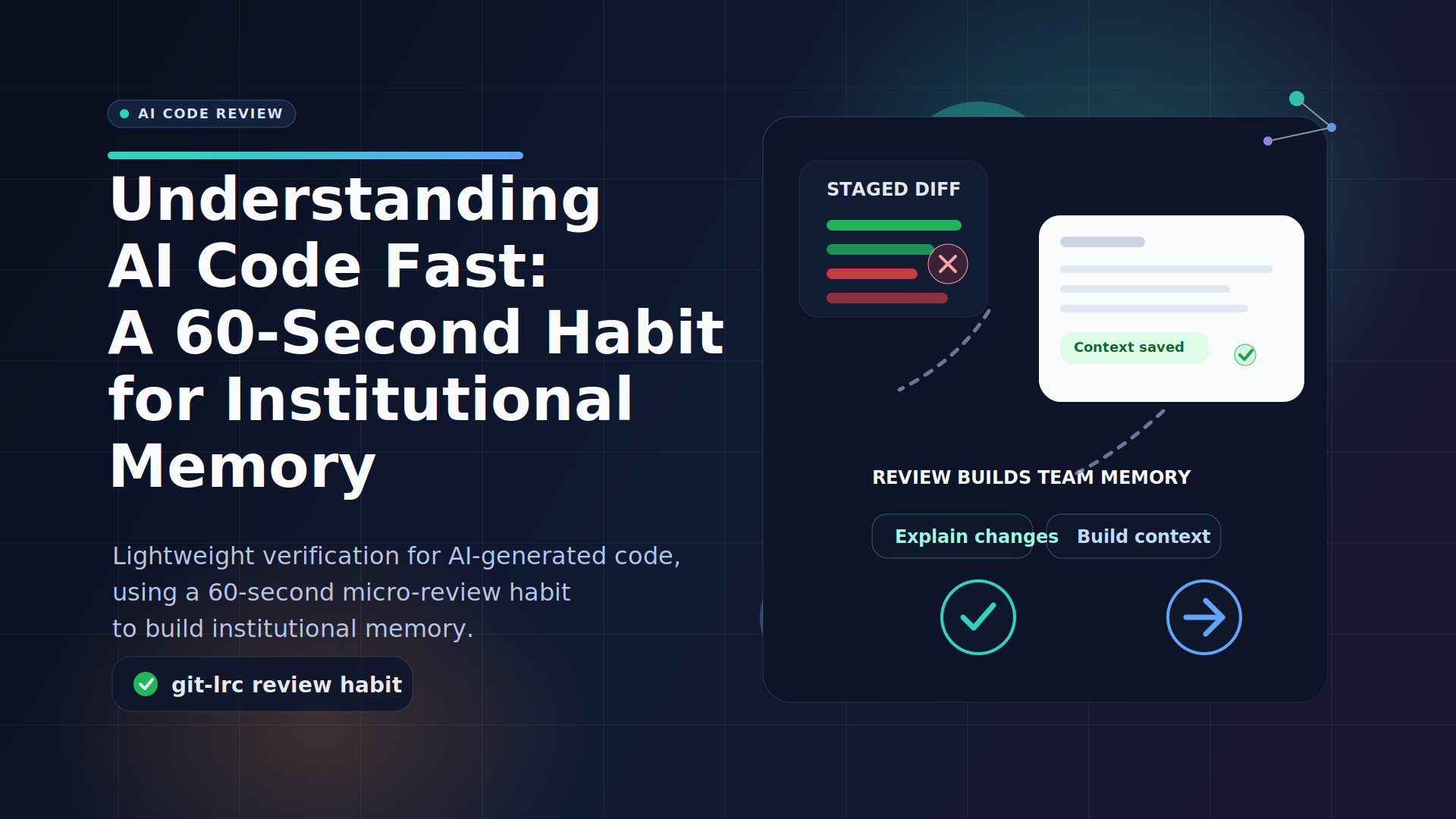
When a team performs code review, it is building institutional memory.
The team is gradually understanding how the system works. It is extremely important that at least a few people understand what a subsystem is doing.
If nobody understands how anything works, then what happens when things go wrong and the agents are not capable enough to solve the issue?
Auditing and intuitive understanding must evolve alongside agentic development.
Both should progress together.
Understanding should grow while automation also grows.
That way, responsibility can be taken, risk can be signed off, and somebody knows enough about the system to deal with failures when they occur.
And failures always occur.
Outages happen.
Customers get impacted.
Architectural mistakes happen. Security problems happen. Performance issues happen.
This is serious work.
At the end of the day, all of this understanding is about maintaining a grip on the system and, therefore, on your future.
Without that grip, your future becomes uncertain.
That is the essence of the Amazon principle: dive deep, audit frequently, and keep checking.
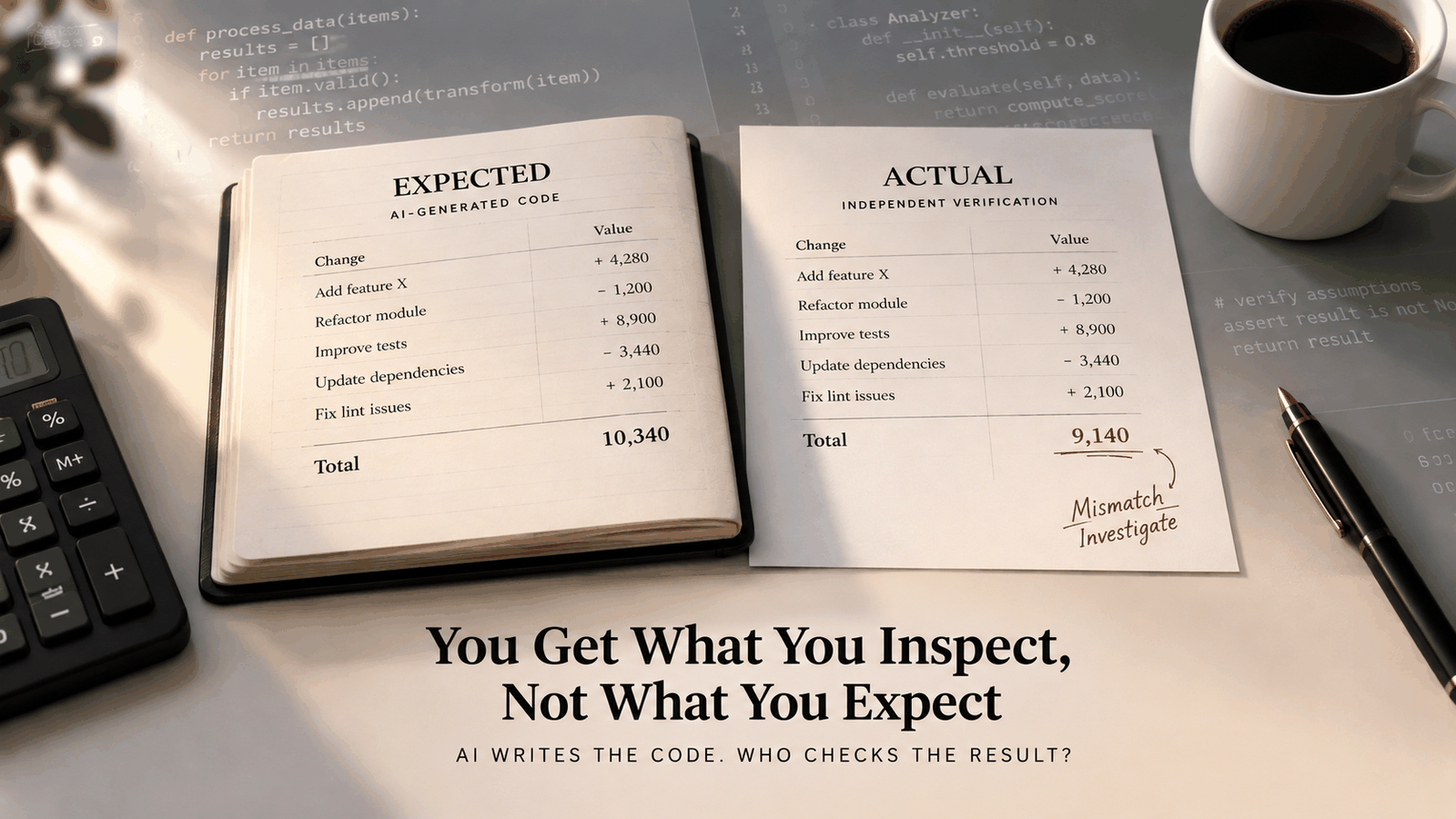
A dashboard may look good, but does it actually match reality underneath?
You have to verify that continuously.
Git-lrc and the 60-Second Review Habit
This brings me to a tool I am working on.
It provides a deck-style summary system called git-lrc.
When you do a Git commit, it generates a slide-style review.
It takes roughly 30 to 40 seconds to go through and inspect the code.
So after git add and git commit, this summary appears locally.

It gives a concise explanation of what is happening in the codebase, along with the actual code itself.
The code is not hidden.
The issues in the code are not hidden either.
An engineer may do this five or ten times a day, and over a month they may perform hundreds of these micro-reviews.
This allows people to stay connected to what is happening underneath the system without having to read every line manually.
git-lrc highlights what is relevant, what may be important, and what deserves attention.
It provides a very fast summary, so there is minimal time waste while still giving assurance and confidence that nothing strange is happening.
It also reduces the burden on senior engineers because reviews happen incrementally, commit by commit.
As a result, institutional memory gets built continuously.
Understanding accumulates over time.
People can vouch for their own changes more confidently.
You move quickly while still remaining relatively safe.
That is the system we are building.
We believe this roughly 60-second review habit can help reduce outages while improving institutional memory.
Closing
That is the core idea I wanted to highlight.
I recommend checking out hexmos.com/git-lrc and trying it out.
Installation instructions are available, and there is also a free version.
So give it a try.